Short Video Hook Ideas: 13 Opening Lines to Look For When You Cut Clips
Thirteen opening lines to look for when you cut Shorts, Reels and TikToks from a long recording, how to write the title hook, and how to tell whether a hook worked.

A hook is the opening of a short video, usually its first sentence and any text on screen, that gives a viewer a reason not to swipe away.
This guide is for creators and clippers who cut Shorts, Reels and TikToks from podcasts, interviews and webinars, and need short video hook ideas they can find in a recording rather than script from scratch.
It covers what the platforms say about the opening seconds, the two hooks every clip has, 13 short video hook ideas worth looking for, how to find them in a transcript, and how to tell whether a hook worked.
The short answer: in a clip, you choose the hook by choosing where to cut. Start on a sentence that promises something, such as a reason, a mistake or a story, then add a short title that sets up the payoff. Klyply scores every candidate clip’s first sentence against these patterns automatically.
Key takeaways
- Instagram tells creators to make sure the first 3 seconds of a reel are engaging so people do not move on.
- Every clip has two hooks: the spoken first line, which you choose by where you cut, and the on-screen title, which you write.
- Thirteen opening patterns, from “here’s why” to “nobody tells you” to “I quit”, turn up again and again in good clips from long recordings.
- YouTube’s Viewed vs swiped away metric shows how often a Short’s opening kept someone watching, which makes it the best test of a hook.
- Klyply gives the opening line the heaviest weight when it picks clips, and adds a title over the first three seconds.
What is a hook in a short video?
A hook in a short video is whatever happens in the first few seconds that makes a viewer want the rest: a line, a question, a claim or a piece of on-screen text.
In a scripted video you write the hook and record it. In a clip cut from a long recording, the words already exist. The hook is a decision about where the clip starts.
That is why most lists of short video hook ideas do not transfer. “Write a bold claim” is no help if the guest never said one. The useful question is which sentences in the recording already work as openings.
Why the first seconds matter
The first seconds matter to any of these short video hook ideas because short-form feeds let viewers swipe instantly, and the platforms themselves tell creators to earn attention early.
Instagram’s creator FAQ says to make sure the first 3 seconds of a reel are engaging, so that people do not move on, and that the early parts of a video should have something interesting to draw viewers in.
TikTok makes a similar point for advertisers. Its creative best practices page says 90% of ad recall impact is captured within the first six seconds, citing its own 2020 research. That figure is about ads, not organic clips, but the logic carries over.
The two hooks in every clip
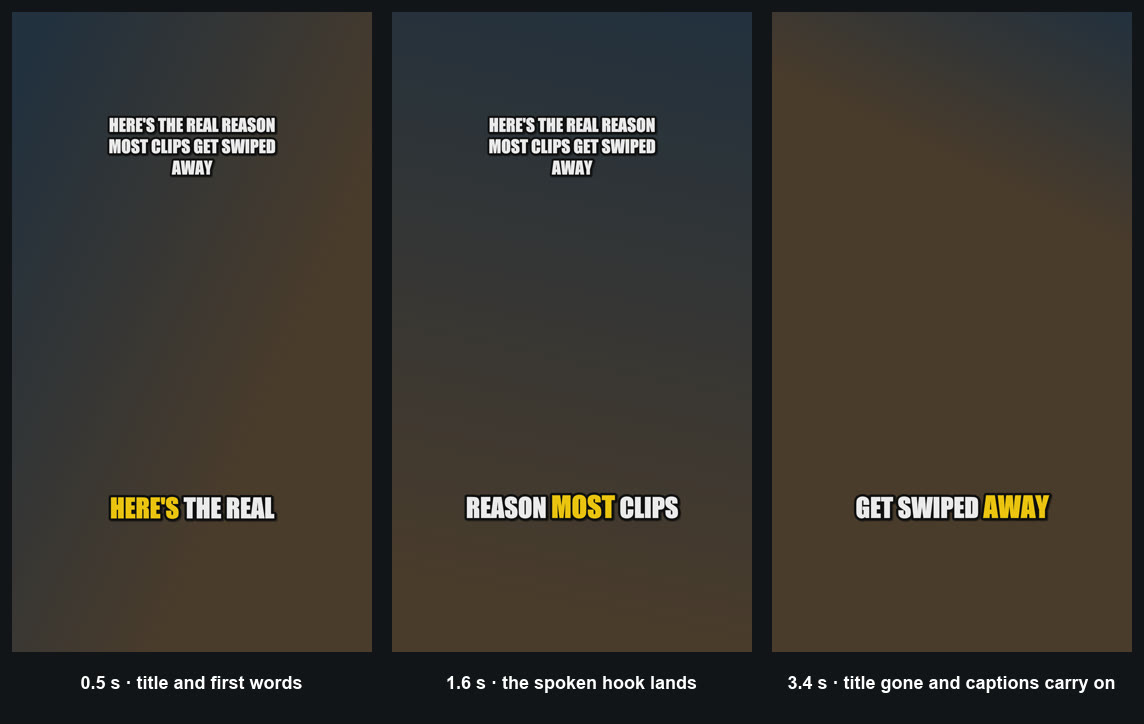
Every clip has two hooks working at once: the spoken hook, which is the first sentence heard, and the title hook, which is the text on screen over the opening seconds.
The spoken hook is chosen, not written. You pick it by moving the start of the clip to a sentence that opens well.
The title hook is written. It is there for the viewer with the sound off, and it can add context the speaker never said aloud, such as who is speaking or what question they are answering.
13 short video hook ideas to look for in a recording
These 13 short video hook ideas are opening patterns that already occur in conversation, so you can find them in a podcast, interview or webinar instead of writing them.
They are the patterns Klyply’s clip scorer looks for in a candidate clip’s first sentence. Treat them as a checklist for spotting openings, not as a guarantee that a clip will perform.
1. “Here’s why” and “This is how”
A sentence that starts “here’s why” or “this is how” is a strong hook because it promises an explanation, and the clip exists to deliver it.
Speakers say it naturally when they reach their main point. Cut the clip to start on those words, and end where the explanation ends.
2. “The real reason” and “The biggest mistake”
Openings like “the real reason”, “the truth is”, “the secret” or “the mistake” work because they suggest the viewer has been told the wrong version.
Check that the clip actually reveals the reason. A “real reason” opening with a vague answer is how clips earn the swipe on the next one.
3. “Nobody tells you” and “Most people think”
“Nobody tells you”, “most people think” and “everyone does” are contrarian hooks: they set up a common belief so the speaker can overturn it.
These are common in interviews with experienced guests. The disagreement is the clip.
4. “Stop” and “Never”
A command such as “stop doing this”, “never sign” or “don’t post” is a hook because it implies the viewer might be making the mistake right now.
Keep the clip going until the speaker says why. A command with no reason sounds like a lecture.
5. “If you” and “When you”
“If you run a small business” or “when you get your first client” is a hook that picks out its audience in the first three words.
It loses everyone else, which is the point. The right viewers stay because the clip is plainly about them.
6. A question: “How do you” or “Why does”
A question in the opening line is a hook because the viewer starts answering it in their head, and wants to know if they were right.
Host questions are an easy source. Start the clip on the question, then let the guest answer.
7. “The biggest” and “The worst”
Superlatives such as “the biggest”, “the worst”, “the hardest” or “the craziest” are hooks because they promise the extreme case, not the typical one.
“The worst client I ever had” almost always leads into a story, which carries the rest of the clip.
8. “I quit” and “We lost”
A first-person event, such as “I quit”, “we lost everything” or “I realised”, is a hook because it opens a story in the middle, where the stakes already exist.
These are the strongest openings in most podcasts. Look for past-tense verbs straight after “I” or “we”.
9. “You’re doing it wrong”
“You need to”, “you have to” and “you’re not” are direct-address hooks that turn the clip into advice for the person watching.
They work best from someone with obvious expertise. From an unknown speaker, add the credential to the title hook.
10. “Imagine” and “Picture this”
“Imagine”, “picture this”, “listen” and “look” are hooks that ask the viewer to do something, which is harder to swipe past than a statement.
“Imagine” usually introduces a scenario. Make sure the clip includes the turn that explains why the scenario matters.
11. “Let me tell you” and “Let me show you”
“Let me tell you” or “I’ll show you” is a hook because the speaker has announced that something worth hearing is coming next.
It works best when the thing promised arrives within a sentence or two. A long wind-up after “let me tell you” wastes the hook.
12. “There are three reasons”
“There are three reasons” or “two things” is a list hook: it tells the viewer exactly how long the payoff will take.
Keep the whole list in the clip. Cutting after reason two breaks the promise the opening made.
13. “Turns out” and “What if”
“Turns out”, “what if”, “believe it or not” and “plot twist” are twist hooks that signal the expected answer is wrong.
They often come in the middle of a speaker’s story. Starting the clip there and letting the speaker explain backwards can work better than starting at the beginning.
What makes any opening stronger
Three small things strengthen any of these short video hook ideas: a question in the first line, a number, and a first word aimed at a person, such as “you”, “I”, “we”, “this”, “stop” or “never”.
Those are the extras Klyply’s scorer adds points for, on top of a matching pattern. “You lost 3 clients because of this?” hits all three.
How to find short video hook ideas in a long recording
The fastest way to find short video hook ideas in a long recording is to search its transcript for the opening phrases above, then check the few sentences after each match.
- Get a transcript with timestamps from your editor, your recording platform or a clipper.
- Search for “here’s”, “the real”, “nobody”, “stop”, “if you”, “the biggest”, “I quit”, “imagine” and “turns out”.
- For each match, read on until the thought finishes. If it finishes within a minute or two, you have a clip.
- Move the start back only if the hook makes no sense without the sentence before it.
- Check the ending. A clip that stops mid-sentence feels broken however good its opening.
Our workflow for repurposing a podcast into short clips covers the rest of the process, from recording to posting.
How to write the title hook
A good title hook is a few words of on-screen text that adds what the spoken hook leaves out: who is talking, what they are answering, or why it matters.
- Add context, do not repeat. If the speaker says “I quit”, the title can say what they quit and why it matters.
- Keep it short. It has to be read in the first seconds, alongside the captions.
- Restate a missing question. When the clip starts on an answer, the title can carry the question.
- Keep it clear of the buttons. Put it high in the frame, inside each app’s safe area, as our guide to vertical video safe zones shows.
Promise only what the clip delivers. A title that oversells gets the swipe a few seconds later instead of straight away, which is no better.
How to tell whether a hook worked
The clearest test of short video hook ideas is YouTube’s Viewed vs swiped away metric, which shows how often people who saw a Short in the feed chose to watch it.
YouTube’s Shorts analytics help describes it as the percentage of times viewers viewed your Shorts versus swiped away, alongside Shown in feed, the number of times a Short appeared in the Shorts feed.
TikTok’s Creator Academy guide to TikTok analytics points to retention rate, the percentage of a video that users watched, and suggests finding the drop-off points. A steep drop in the first seconds is a hook problem.
On Instagram, trial reels are shown to non-followers first, so you can try two openings of the same clip on people who have never seen you before sharing the better one with everyone.
Compare clips from the same recording. If the clips that open on a story keep more viewers than the clips that open on advice, your audience has told you which hooks to look for next time.
Our guide to turning a YouTube video into Shorts covers posting and YouTube’s own clipping tools.
How Klyply picks hooks for you
Klyply finds hooks automatically: it transcribes the recording on your PC, scores every candidate clip, and gives the opening sentence more weight than anything else in the score.
The score behind each clip
Klyply’s clip score is a weighted blend of seven signals, and the hook carries the heaviest weight.
| Signal | What it measures | Weight |
|---|---|---|
| Hook | The 13 opening patterns, plus a question, a number or a direct first word | 2.6 |
| Language | Emotional and concrete words, and words that build curiosity | 1.8 |
| Energy | How loud and lively the voice is | 1.5 |
| Length | How close the clip is to a target length inside the bounds you set | 1.2 |
| Pace | Words per second | 1.0 |
| Ending | Whether the clip ends on a complete sentence | 0.9 |
| Filler | “Um”, “like” and similar, which lower the score | -1.1 |
The weights are design choices, not research findings. They are published here so you know what the tool is looking for, and can override it when your audience proves it wrong.
The hook title
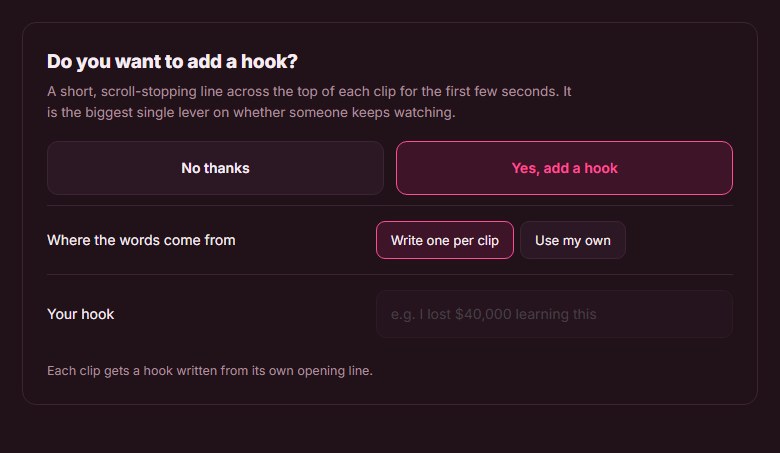
Klyply adds a hook title across the first three seconds of every clip, taken from the clip’s first sentence and trimmed to 60 characters.
You can type your own instead, up to 120 characters. A typed hook applies to every clip in the batch, so it suits a series name or a guest’s name better than a line written for one clip.
What Klyply costs and where it falls short
Klyply costs $29 for 3 months or $179 for a Lifetime licence, with a 12-month term in between, and it runs on Windows 10 and 11 with nothing uploaded.
A fixed term starts at activation, and you can get a refund within 14 days of purchase as long as the key has not been activated.
- The hook patterns are written for English. Clips in other languages are still scored on energy, pace and length, but miss the pattern match.
- A typed hook title applies to the whole batch, not to one clip.
- There is no transcript editor and no way to nudge a clip’s start point by hand.
- It renders on your PC’s processor, so a long recording takes longer on an older computer.
Common hook mistakes
Most weak video hooks in clips come from four mistakes, and all of them are about where the clip starts or what the title promises.
- Starting at the beginning of the answer. Speakers warm up. The hook is often the second or third sentence, not the first.
- Starting with “so” or “yeah”. A clip that opens on filler sounds like it started by accident.
- A hook with no payoff. “The real reason” followed by a shrug teaches viewers to swipe your next clip sooner.
- A title that repeats the captions. If the title and the first caption say the same words, one of them is wasted.
Short video hook ideas FAQs
How long should a video hook be?
A video hook should land within the first few seconds; Instagram’s own advice is to make the first 3 seconds of a reel engaging. In a clip, that usually means the first sentence.
What are the best hooks for Shorts?
The best hooks for Shorts promise something specific the clip then delivers: a reason, a mistake, a story or a list. For clips from long recordings, look for openings like “here’s why”, “nobody tells you” and “I quit”.
Do I need text on screen if the speaker has a good opening line?
Yes, add a short title even with a strong opening line, because many viewers watch with the sound off and only see the text. Use it to add context rather than repeat the line.
Can you add a hook to a clip after recording?
Yes, you add a hook after recording in two ways: by moving the clip’s start to a stronger sentence, and by adding a title over the opening seconds.
Are clickbait hooks a good idea?
No, a hook the clip does not pay off costs more than it gains, because viewers swipe away a few seconds later and learn to skip your clips. Promise exactly what the clip delivers.
How do I know which hooks work for my audience?
Compare Viewed vs swiped away in YouTube Analytics across clips from the same recording. The hook types with the highest viewed share are the ones to look for next time.
Final thoughts
The best short video hook ideas for clips are already in your recordings: a speaker saying “here’s why”, “nobody tells you” or “I quit” is handing you an opening.
For a few clips a week, search the transcript for those phrases and cut by hand.
For a batch of clips from every episode, Klyply scores every opening line against these patterns, picks the strongest moments and adds a hook title, all on your own PC.
Then let the numbers decide which short video hook ideas to keep. The ones your viewers stay for are what to look for in the next recording.